
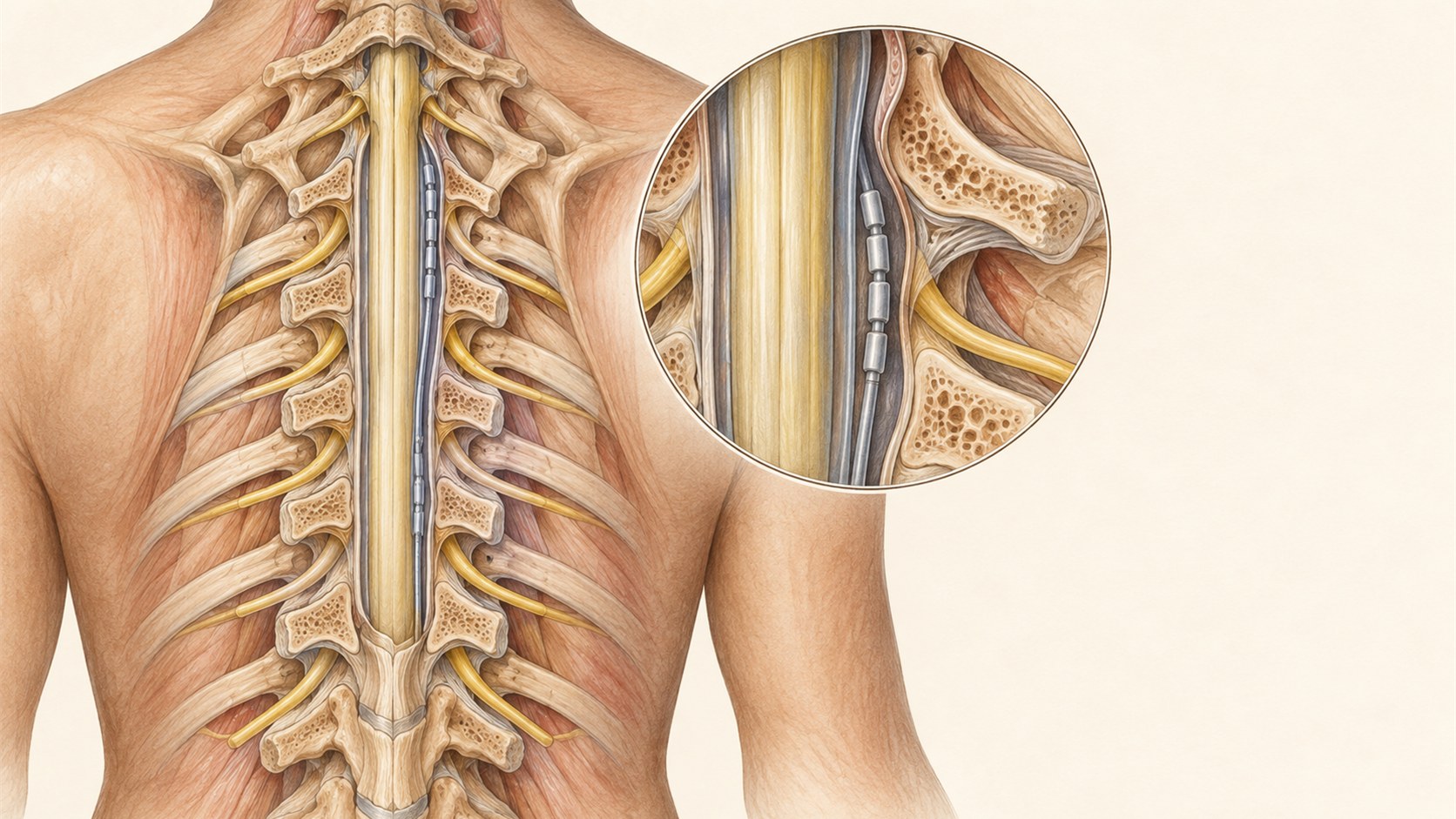
The target is near the spinal cord, not a single peripheral nerve.
Neuromodulation
Spinal Cord Stimulation
Spinal cord stimulation uses leads in the epidural space to change pain signaling. It may be considered for selected chronic neuropathic pain patterns, but the diagnosis, prior care, goals, and risks must be reviewed before a trial.
Quick orientation
What to know first
A temporary trial tests a defined functional goal before permanent implantation is considered.
Evidence depends on the diagnosis; durable benefit and complication risk remain individual.
Target and mechanism
What is spinal cord stimulation?
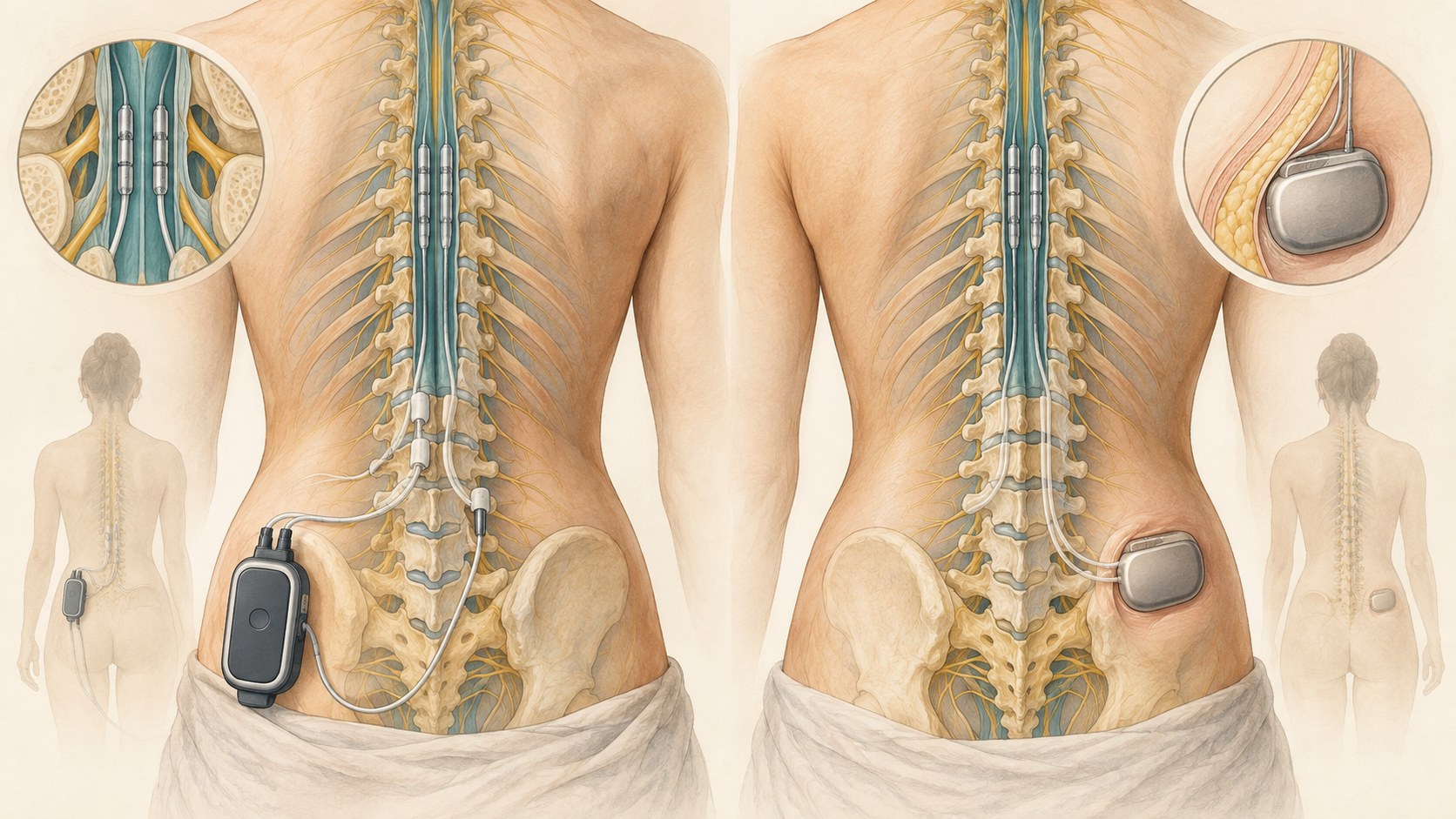
Spinal cord stimulation is a form of neuromodulation. Thin leads are positioned in the epidural space, outside the spinal cord, and deliver programmed electrical stimulation intended to change pain signaling. A temporary trial and a permanent implant are separate decisions.
Patient selection
Who is spinal cord stimulation for?
SCS may enter the discussion when a confirmed neuropathic pain pattern matches the proposed target and meaningful limits remain after appropriate care. It is not automatically appropriate for nonspecific low back pain or every chronic pain condition.
A confirmed chronic neuropathic pain pattern with symptoms that match the proposed target
Meaningful limits despite appropriate nonoperative and other indicated care
Realistic, measurable goals for function, sleep, medication burden, or activity
Ability to participate in trial assessment, wound care, programming, and follow-up
Related care
Conditions this treatment may be considered for
These related guides show educational connections. They do not establish candidacy, a recommendation, or a required sequence.
Therapeutic Consideration
Persistent Post-Surgical Spine Pain
May be considered within a trial-based neuromodulation pathway after cause-oriented reassessment and selection.
Explore this pageTherapeutic Consideration
Painful Diabetic Neuropathy
May be considered within an approved-label, trial-based neuromodulation pathway after diagnosis and selection.
Explore this pageTherapeutic Consideration
Complex Regional Pain Syndrome
May be considered within a trial-based neuromodulation pathway after multidisciplinary diagnosis and selection.
Explore this pageTherapeutic Consideration
Chronic / Low Back Pain
For selected persistent back and leg pain after other care, including after spine surgery and, with some devices, selected cases without prior surgery; a trial comes first
Explore this pageTherapeutic Consideration
Peripheral Neuropathy
For selected painful diabetic neuropathy of the feet and legs that has not responded to other care, with a trial first; it does not reverse nerve damage
Explore this pageTherapeutic Consideration
Nerve Pain
For selected persistent nerve pain syndromes after other care, with a trial first; results depend on the diagnosis
Explore this pageEvidence at a glance
What benefits are realistic?
The goal is not a guaranteed pain score. A useful result may include meaningful progress in walking, sleep, daily activity, medication burden, or participation in rehabilitation. Benefits vary by diagnosis, system, and individual response, and can change over time.
Agree on measurable functional goals before a trial.
Judge the trial by activity and function as well as pain.
A successful trial can inform the implant decision but cannot guarantee durable benefit.
Decision process
How candidacy is evaluated
Evaluation should confirm the diagnosis and pain distribution, review imaging and prior care, assess medical and psychosocial risk, and compare reasonable alternatives. The discussion should also establish whether the patient can participate in trial assessment, wound care, programming, and follow-up.
Confirm the diagnosis and the proposed neural target.
Review prior treatment, imaging, medical risk, and psychosocial factors.
Define measurable trial goals and discuss reasonable alternatives.
A staged decision
What happens during an SCS trial?
A trial uses temporary leads connected to an external controller for a limited assessment. Goals should be agreed on before the procedure. During the trial, the patient and care team review activity, function, pain, sleep, medication use, and adverse effects. The leads are then removed, and the result is reviewed before any separate implant decision.
A trial is temporary and does not place the permanent pulse generator.
Trial success should be judged against the goals set before the procedure.
Meeting trial goals does not guarantee long-term benefit after implantation.
Decision quality matters
Permanent implant, programming, and follow-up
If the trial meets the agreed goals and no new concern changes the balance, a separate permanent implant may be considered. The implanted system includes leads and a pulse generator placed under the skin. Programming and follow-up are ongoing parts of care. Charging requirements, MRI conditions, and future-procedure precautions depend on the exact system.
The trial and permanent implant are separate decisions.
Programming may require adjustment as goals or symptoms change.
Device-specific instructions should be confirmed before MRI or another procedure.
The visit
Recovery after an SCS procedure
Recovery is individualized and differs between trial-lead removal and permanent implantation. Patients should follow the treating team instructions for wound care, activity, driving, medication, and follow-up. New weakness, fever, drainage, increasing redness, severe new pain, or a device problem requires prompt clinical contact.
Protect the procedure or incision site as directed.
Keep scheduled wound and programming follow-up.
Ask the treating team when work, exercise, driving, and other activities may resume.
Risks and limits
Spinal cord stimulation risks and limits
Randomized evidence supports SCS for selected persistent neuropathic leg pain after spine surgery and for refractory painful diabetic neuropathy. Evidence for nonspecific low back pain is more uncertain, and placebo-controlled reviews raise important limitations. Long-term benefit may diminish. Alternatives depend on the diagnosis and may include further diagnostic work, rehabilitation, medication review, targeted procedures, or surgical reassessment.
A successful trial does not guarantee permanent benefit.
Infection, bleeding, neurologic injury, lead movement or damage, loss of benefit, revision, and removal are material considerations.
MRI compatibility and future procedures depend on the exact system.
Choosing continued nonoperative care or another diagnosis-specific pathway may be reasonable.
Common questions
Spinal Cord Stimulation FAQ
These answers are educational and cannot determine an individual diagnosis or treatment plan.
What is the difference between the trial and implant?
The trial uses temporary leads and an external controller for a limited assessment. A permanent system places the pulse generator under the skin.
How is trial success evaluated?
The patient and care team compare the trial with measurable goals set before the procedure. Activity, function, pain, sleep, medication use, adverse effects, and the ability to use the system may all matter.
Does a successful trial guarantee long-term relief?
No. It can inform the decision, but benefit can change and device-related problems can occur later.
Is SCS only for pain after spine surgery?
No. It may be considered for several selected neuropathic pain indications, but evidence and regulatory status differ by diagnosis.
Can every SCS system be used during an MRI?
No. MRI conditions depend on the exact system and its components. Device-specific instructions must be checked before scheduling an MRI.
Does every implanted system require charging?
No. Charging and battery features vary by system. The device options and maintenance requirements should be reviewed before implantation.
Learn what may come next
Related guides.
Use these links to learn about related symptoms, conditions, and treatments. An individual evaluation is still needed to determine a diagnosis or whether a treatment may be appropriate.
Care overview
Neuromodulation
Compare approved neuromodulation pathways and understand how modality selection differs by diagnosis, anatomy, and goals.
Open this guideSpecific treatment
Dorsal Root Ganglion (DRG) Stimulation
Understand DRG stimulation for selected focal neuropathic pain presentations, including trial and selection context.
Open this guideSpecific treatment
Peripheral Nerve Stimulation
Understand peripheral nerve stimulation for selected named peripheral-nerve pain presentations.
Open this guideSpecific treatment
Vagus / Auricular Neuromodulation
Understand the actual nontraditional vagus/auricular neuromodulation service offered by the practice without implying implanted cervical VNS for epilepsy.
Open this guideTarget before technology
Discuss spinal cord stimulation with Solutions in Pain
Patients from Allen, Wylie, and nearby North Texas communities can request a consultation to review whether SCS or another pathway fits the diagnosis.
Learn about our Allen office and Wylie office.